
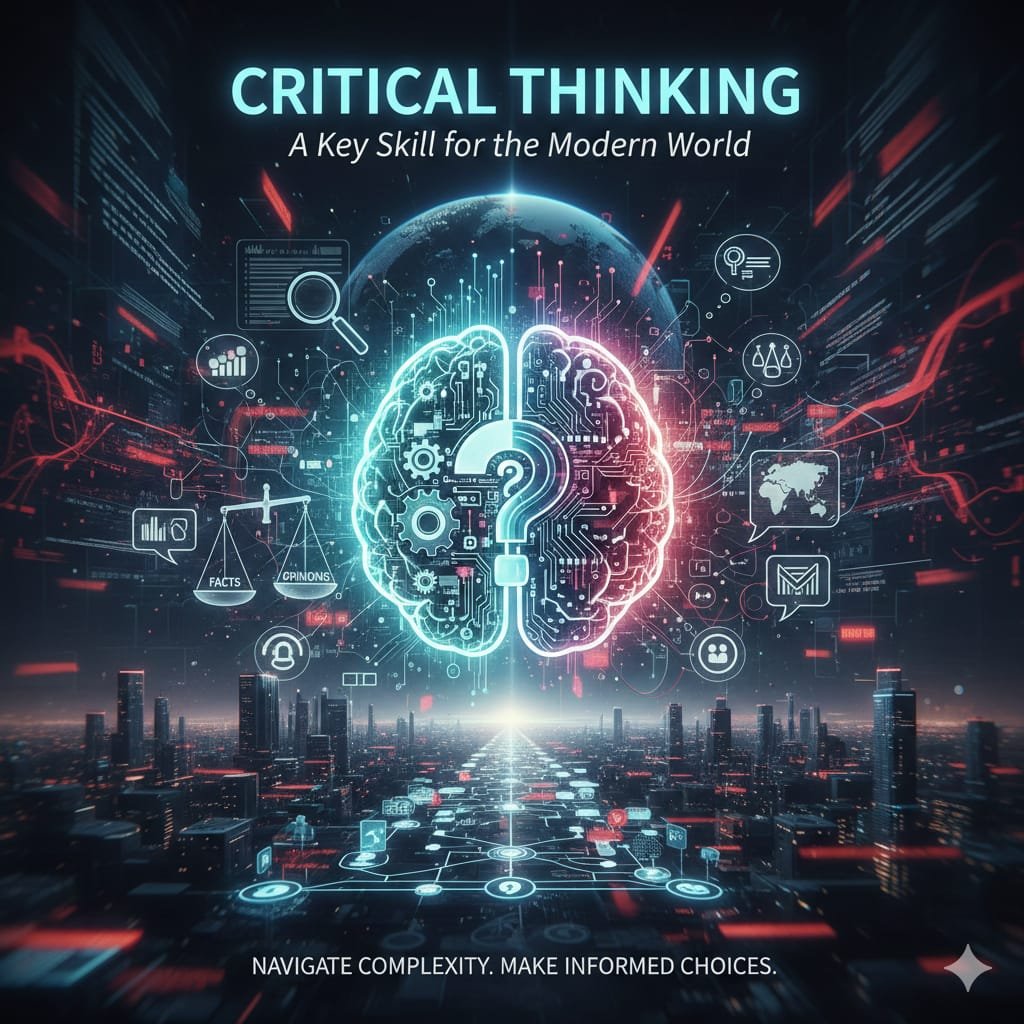
We live in a time when we are exposed to an overwhelming amount of information, often contradictory, emotionally charged, or deliberately biased. In such an environment, critical thinking is not simply a useful ability; it is an essential tool for navigating the complexity of modern society. Our personal, professional and civic decisions are rarely purely rational, which is why we must develop the capacity to analyse, question and evaluate the information we rely on.
Critical thinking is commonly defined as the ability to systematically and objectively evaluate information to reach well-reasoned conclusions. Ennis describes it as “reasonable, reflective thinking focused on deciding what to believe or do.” Paul and Elder define it as an effort to improve the quality of our thinking by analysing and assessing it based on logic and evidence.
In practice, critical thinking is not about constant pessimism or rejecting ideas by default. It is about pausing to ask the right questions: Who is saying this? Why now? What is missing? It means examining the source, not only the message. In an age where anyone can publish data, charts or claims, we must ask: Where does the information come from? Is it based on research, marketing, political messaging or personal belief?
One of the most difficult aspects of critical thinking is questioning our own assumptions. We all have “blind spots” shaped by personal beliefs, cultural norms, political preferences or experience. We tend to accept ideas that fit what we already believe and dismiss those that challenge us. A critical thinker evaluates ideas based on substance, not on where they come from or who states them. A crucial element of critical thinking is distinguishing facts from opinions. While both are legitimate forms of communication, they are not the same. Facts describe reality; opinions interpret it. Critical thinking allows us to separate the two and to recognise whether we are responding to verified information or personal judgement.
Today, the challenge is no longer accessing information but managing its excess. We are flooded with news, statistics, advertisements, misinterpretations and misinformation. The ability to analyse, verify and interpret information becomes indispensable.
Critical thinking helps us recognise reliable sources, understand arguments and evaluate evidence rather than react instinctively. Nobel laureate Daniel Kahneman explains that intuitive thinking is fast and automatic, while critical thinking is slower, analytical and evidence-based.
Global organisations such as UNESCO and OECD identify critical thinking as one of the key skills of the 21st century – fundamental to innovation, citizenship and sustainable education. Yet many educational systems still prioritise memorisation over reasoning, questioning and problem-solving. As Stephen Brookfield argues, quality education is not only about acquiring information but also about the ability to interpret and apply it in new contexts.
In a world that demands quick answers yet offers countless superficial solutions, critical thinking becomes a safeguard against manipulation, misinformation and poor decision-making. It enables us to make thoughtful, informed and responsible choices, whether as professionals, students, consumers or citizens.
Ultimately, critical thinking is more than an academic concept. It is a life skill that shapes not only how we think, but how we understand the world, communicate with others and make decisions.
Prof. Maja Drakić-Grgur, PhD and Maja Junčaj, MSc
University Donja Gorica